
People · Places · Evidence
Lives Within Virginia History
An expanding exhibit about the people connected to Virginia’s early King families—and the records, landscapes, voyages, and unresolved questions that bring their worlds into view.
Find a person or story
Examples: Sidney King, Diamond, Jamestown, land patent, World War II, Gloucester, or Edna Dunn.
Featured people

1609 · The Third Supply
Captain William King and the Diamond
A King family tradition reaches into one of Jamestown’s most dangerous years—but the identity of the captain remains a question to be proved, not a conclusion to be assumed.
In June 1609, the Virginia Company sent a fleet of nine ships toward Jamestown with hundreds of passengers, livestock, and provisions. The expedition was intended to strengthen a colony that remained precarious two years after its founding.
A hurricane scattered the fleet in July. The flagship Sea Venture was driven onto Bermuda, one vessel disappeared, and the remaining ships struggled onward separately. The Diamond and the Swallow reached Jamestown on August 18, a week after four other ships arrived.
The arrival was not a simple rescue. The surviving ships had lost supplies, and the newcomers entered a settlement already under severe strain. Disease, hunger, political disorder, and worsening conflict with the peoples of Tsenacomoco soon carried Jamestown into the winter remembered as the Starving Time.
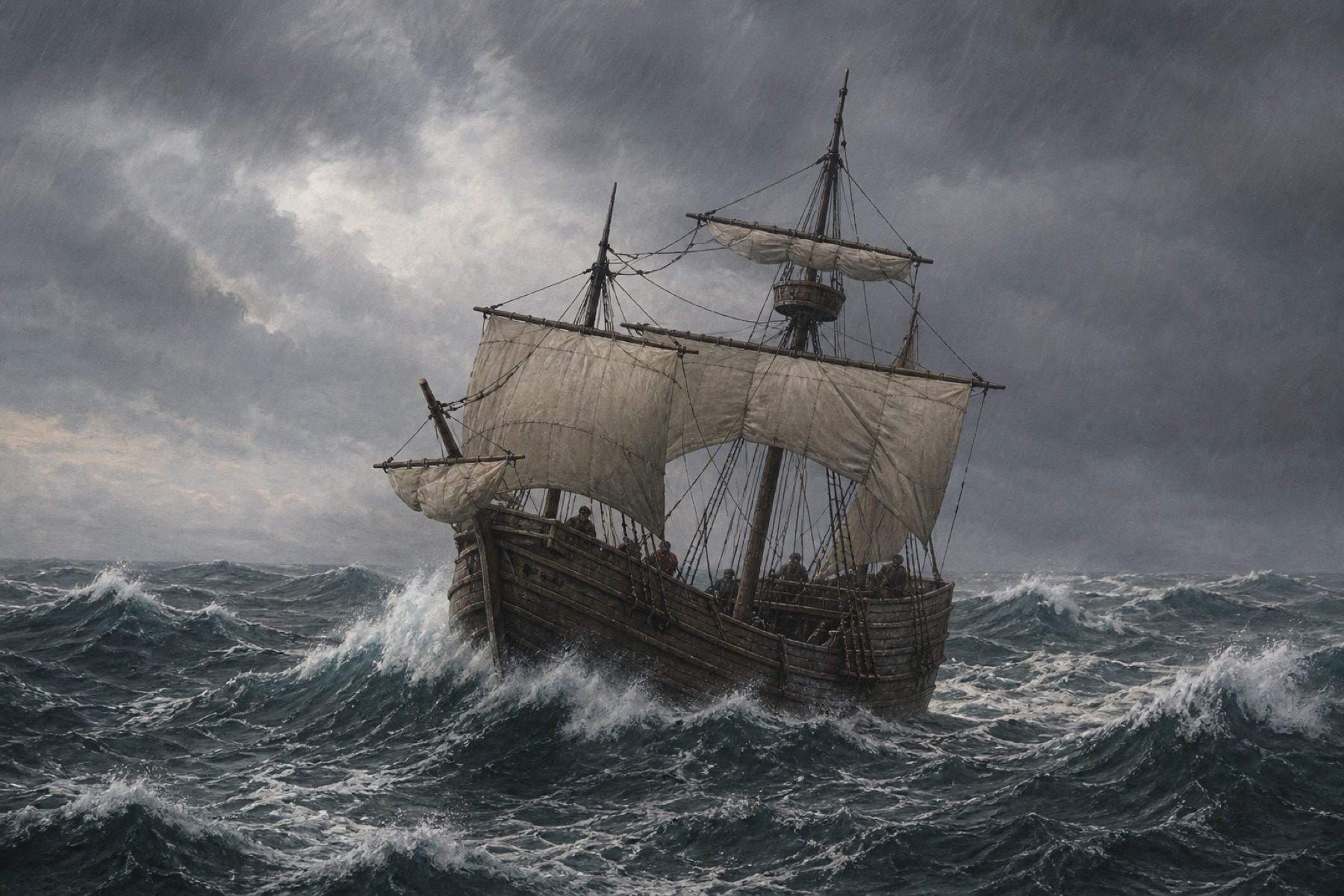
What might the Diamond have looked like?
No verified portrait or construction drawing of the Diamond has been located. A vessel serving the Virginia Company in 1609 would have been a wooden, square-rigged sailing ship dependent upon wind, practiced seamanship, and a crew working exposed decks and rigging. The illustration above is meant to help a visitor imagine that maritime world—not to reconstruct the ship’s exact hull, rig, markings, or size.
Was the Diamond lost near Ushant?
One online King family history places the loss of the Diamond near Ushant, France, on September 28, 1609. That claim conflicts with the voyage chronology presently documented: the Diamond reached Jamestown on August 18, and a historical account places it among the ships that left Virginia in October carrying Captain John Smith and others back toward England. For that reason, this exhibit does not present an Ushant wreck as established fact.
The location itself is plausible as a place of maritime danger. Ushant—Ouessant in French—lies off Brittany at the western entrance to the English Channel. Rocky approaches, strong currents, fog, exposed water, and limited shelter made the area hazardous long after 1609. A French regional heritage record counted thirty-one ships lost in the approaches between 1888 and 1904 alone. Those later losses demonstrate the danger of the waters, but they do not prove that the 1609 Diamond was among them.
What can we say about Captain King’s life?
The surviving outline is frustratingly brief. Voyage lists identify William King as a captain or mariner associated with the Diamond and indicate that he did not remain in Virginia. That small detail matters: his known place in the story is aboard a working Atlantic vessel, not as a documented Jamestown settler, landowner, or founder of a Virginia household.
His title also tells us something about his world, though not his exact duties. A captain crossing the Atlantic in 1609 needed practical knowledge of winds, currents, rigging, provisions, discipline, and the judgment required when ships became separated. It does not tell us where William was born, how long he had been at sea, or whether “captain” described command of the Diamond, another responsibility within the fleet, or the title by which later writers remembered him.
A family mystery: clues and leads
Several online family histories describe the mariner as a William King born in Cheshire about 1543 or 1544. They name Blanche Mainwaring as his wife and most often identify three sons—John, Ralph, and Thomas. In that tradition, John King also became a captain, was associated with a ship called the Falcon, and later participated in Atlantic trade involving Barbados and Virginia.
These claims are interesting leads, but they are not yet a documented family group for the man aboard the Diamond. The online pedigrees disagree about birth years, William’s parents, the number and names of his children, and even whether Blanche’s husband was William or Thomas King. Some assign the couple three children; others assign ten or fifteen. Repetition across family trees is not independent evidence when the trees appear to copy the same unsourced tradition.
For now, the most responsible answer is that Captain King may have had the family described in these pedigrees, but the relationship remains unproved. These names are kept here as clues so they are not lost, while the page avoids turning them into facts. His documented story is maritime; the claimed line from Cheshire into Virginia is the next part of the investigation.
Some genealogical accounts identify a Captain William King with the Diamond. At present, the sources reviewed for this exhibit establish the ship’s place in the Third Supply but do not yet establish that this William King belonged to the Virginia King family lines studied here. Other historical accounts identify John Ratcliffe as commander of the Diamond. Until a contemporary record resolves the discrepancy, the William King identification remains an open research question.
Sources and research trail
- Virginia Humanities, “Early Jamestown Settlement”, including the 1609 timeline.
- Historic Jamestowne, “History Timeline”, 1609 entries.
- Library of Congress, “Virginia Records Timeline: 1600 to 1609.”
- Alexander Brown, The First Republic in America, for the October 1609 return voyage.
- King and Williamson Families, “John King”, the genealogical page carrying the Ushant claim; treated here as a lead rather than proof.
- Brittany Cultural Heritage Inventory, “Phare de la Jument”, for the later record of losses in the approaches to Ouessant.
- Brittany Cultural Heritage Inventory, “Ensemble fortifié (Ouessant)”, for the area’s rocks, currents, fog, and limited shelter.
- Martha W. McCartney, Virginia Immigrants and Adventurers, 1607–1635, a biographical reference assembled from early Virginia records.
- “Captain William King, my 10th great grandfather”, an example of the family tradition naming Blanche Mainwaring and sons John, Ralph, and Thomas; used as a research lead, not independent proof.
- FamilySearch, “Blanche Mainwaring”, illustrating both the repeated family grouping and the larger, conflicting list of children attached to it.
Research note: Neither the William King identification nor the claimed Ushant loss is listed as documented fact. A contemporary ship list, Virginia Company record, port record, casualty record, or equivalent primary evidence is still being sought.
10 October 1651 · Gloucester County
John King and a Place on the Map
A brief land patent places a man named John King beside two Tidewater creeks in 1651. It tells us where his claim lay and how it was granted—but it does not yet prove where he came from or which later King family called him ancestor.
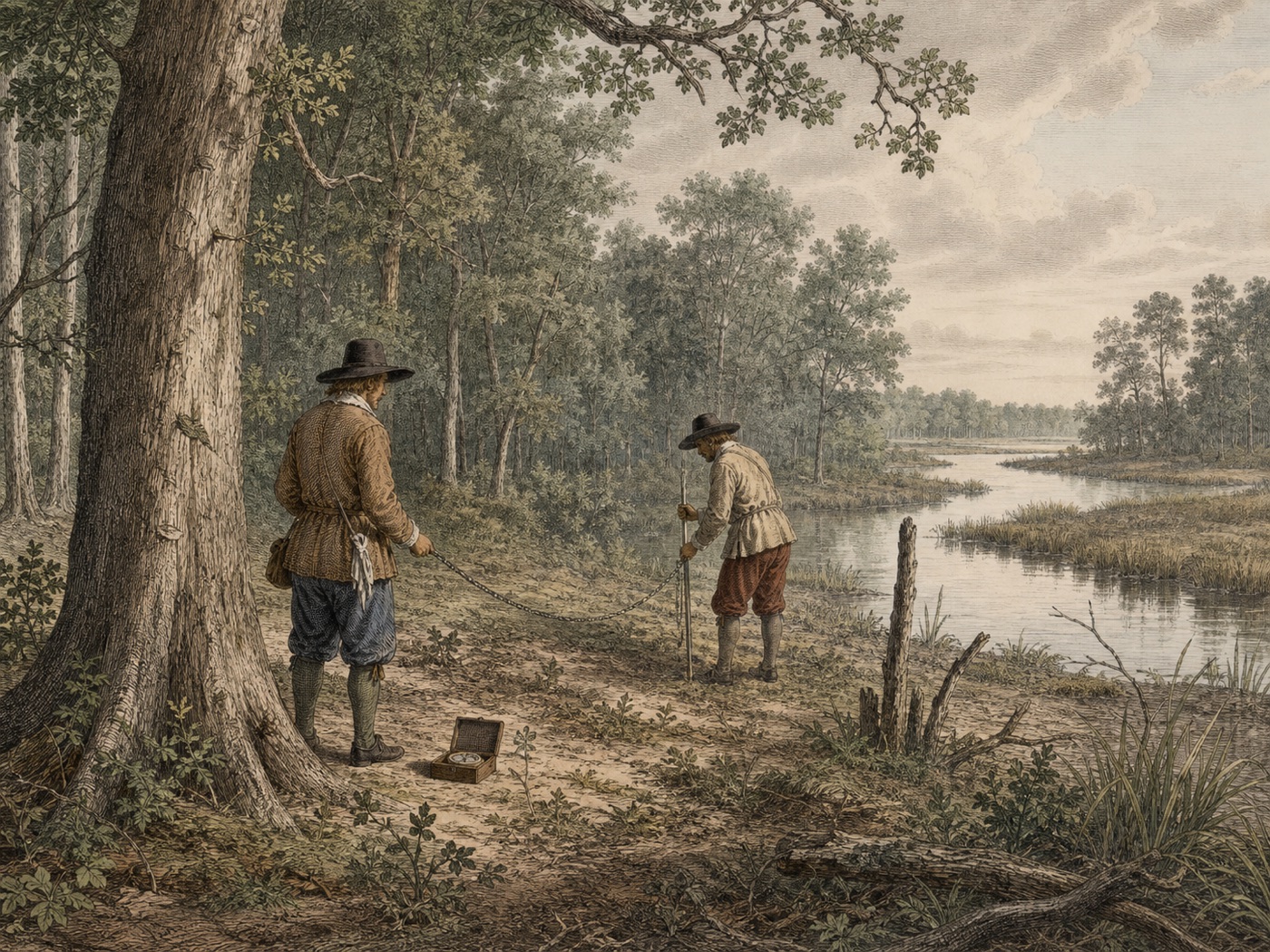
On 10 October 1651, Virginia’s colonial government granted John King 200 acres in Gloucester County. The patent located the tract on the northwest side of Poropotank Creek and toward the head of Bennett’s Creek, adjoining land associated with Thomas Leachman and John Bennett.
The boundary language brings the landscape closer: a small swamp, marked trees, creek heads, and neighboring claims. A patent did not arrive with the neat modern lines of a subdivision map. Surveyors and residents identified land through waterways, trees, bends, and the holdings of people already nearby.
What “patenting land” meant
The acreage was granted under Virginia’s headright system for the transportation of four people into the colony. The record names Alice Kelley, a person whose name was read by a later abstractor as Welts or Wells Mander, Francis Williams, and James Town. Their appearance in the patent does not by itself show that John King personally brought them across the Atlantic, that they lived on this tract, or what later became of them. Headrights could be assigned and traded, so each name is a research lead rather than a complete life story.
A later patent dated 28 October 1658 enlarged the holding to 450 acres and described the original 200 acres as land patented by King in 1651. That later record also says the patent was renewed in the name of Richard King, identified as John’s son and heir, in 1662. This provides a stronger family clue than a repeated online tree: it names a relationship within the land record itself.
A changing county around the same land
The place-name can be confusing because county boundaries changed. The 1651 document called the location Gloucester County. By the 1658 renewal, the same general tract was described as New Kent County. The land did not move; colonial jurisdictions were being divided and renamed around it.
Is he part of the King family in this exhibit?
Peyton Neale Clarke’s 1897 Old King William Homes and Families begins its King sketch by mentioning this patent. That makes John an important person to investigate, but Clarke did not document a generation-by-generation descent from John to Walter King, Colonel Carver King, or Colonel Robert King. For now, the patent proves John’s presence and names Richard as his son and heir. A connection to the later King William County family remains to be demonstrated.
Sources and research trail
- Virginia Land Office Patents No. 2, 1643–1651, p. 345 (Reel 2), John King, 200 acres, Gloucester County, 10 October 1651.
- Virginia Land Office Patents No. 4, p. 327–328, John King, 450 acres, New Kent County, 28 October 1658, including the later renewal notation naming Richard King as son and heir.
- Peyton Neale Clarke, Old King William Homes and Families (1897), p. 68, King family sketch. Clarke is used as a research guide, not as proof of every relationship it suggests.
- Nell Marion Nugent, Cavaliers and Pioneers, abstract of the 1651 patent, preserving the acreage, waterways, adjoining owners, and headright names.
1922–1944 · 315th Infantry Regiment
Sidney Fendel King: The Father His Sons Never Met
He was twenty-two years old, newly married, and expecting children when war carried him from Portsmouth to Europe. Sidney Fendel King died on 16 December 1944. His twin sons were born nearly four months later.
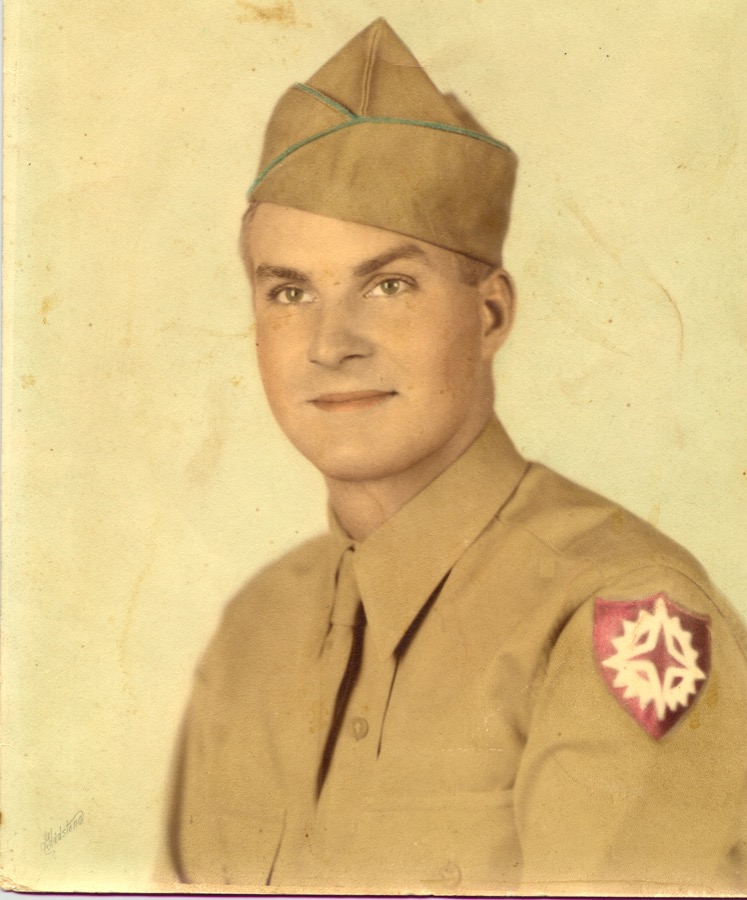
A young life before the uniform
Sidney Fendel King was born on 21 July 1922 to Roland and Willie King. On 23 October 1943, he married Olivette Elizabeth Aston in Camden, North Carolina. These spare dates mark a life moving quickly into adulthood: a marriage during wartime, two children expected, and a future being planned under the shadow of military service.
His mother died soon after his birth. After his father remarried, family memory says that Sidney was raised principally by his aunt Edna Louise King Dunn, wife of Otto Bindawall Dunn. Her care gave him an enduring home during a childhood shaped by early loss and changes within the household. The surviving family account is clear about Edna’s importance in his life, although records documenting when he lived with her are still being sought.
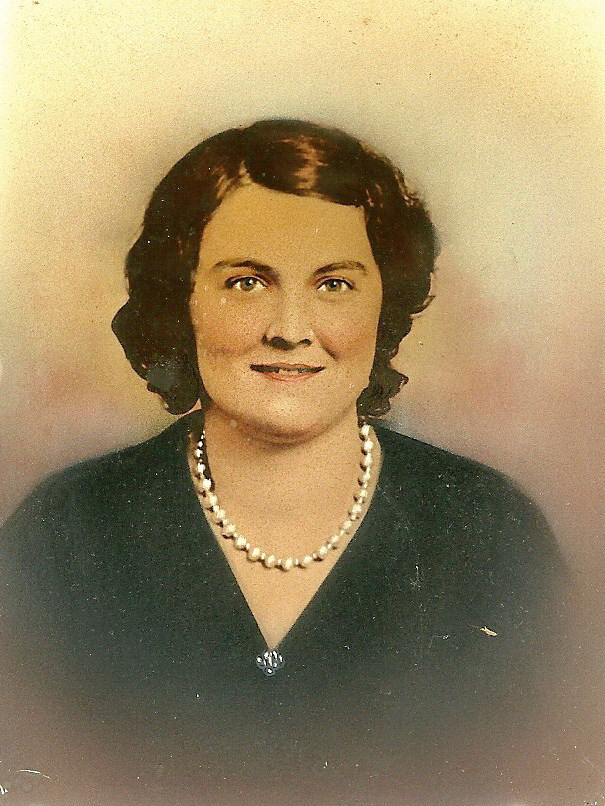
The children were twin sons, born on 11 April 1945. By then their father had been dead for almost four months. They could know him only through photographs, records, and the memories of other people. That absence—not an invented account of a final heroic act—is at the heart of his story.
Before Europe: Panama and a final visit home
A surviving handwritten poem now provides direct evidence that King served at Fort Amador in the Panama Canal Zone before he was sent to Europe. The heading appears to identify him with Battery R, 73rd Coast Artillery (Antiaircraft). Because the manuscript is undated and his individual orders have not yet been located, it does not establish the complete dates or itinerary of that assignment.
Panama was not a minor wartime outpost. The canal was essential to moving ships, troops, and equipment between the Atlantic and Pacific. The Army guarded its locks, dams, airfields, and approaches against attack or sabotage. By the end of 1942, almost 67,000 Army personnel were serving at bases and other defense sites in Panama. As the threat to the canal diminished, many troops were reassigned to active fronts, and by 1944 the area increasingly served as a training ground.
In his own words
The Fort Amador manuscript introduces the poem as the work of Private Sidney F. King and Private First Class Charles L. Verbeck. They called it “Down in Panama.” Its verses describe the tropical heat, mosquitoes, lizards, long workdays, military discipline, homesickness, and the hope of someday finding peace and rest away from Panama. This is not an official service record, but it preserves something those records rarely contain: how two young soldiers chose to describe their daily experience.
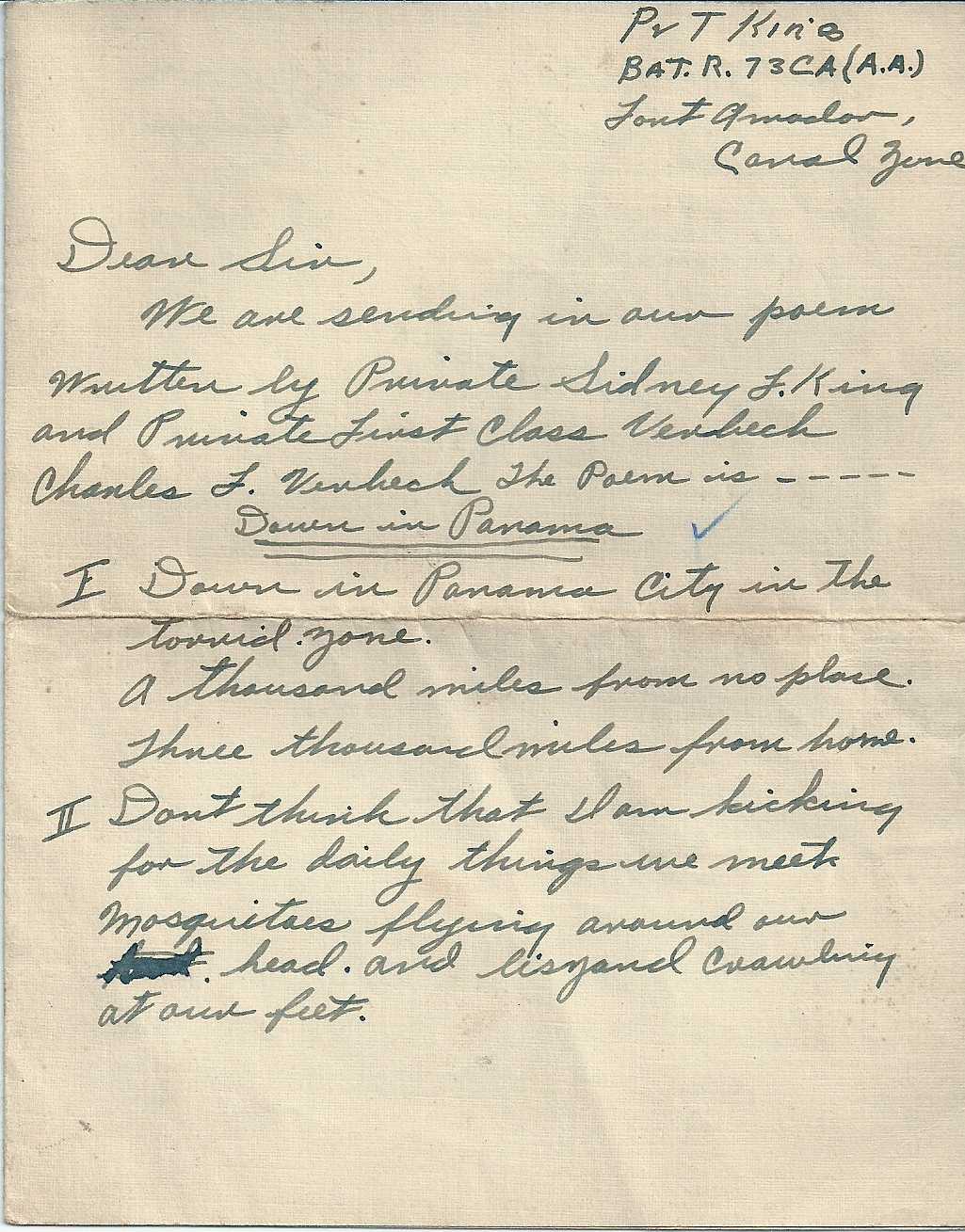
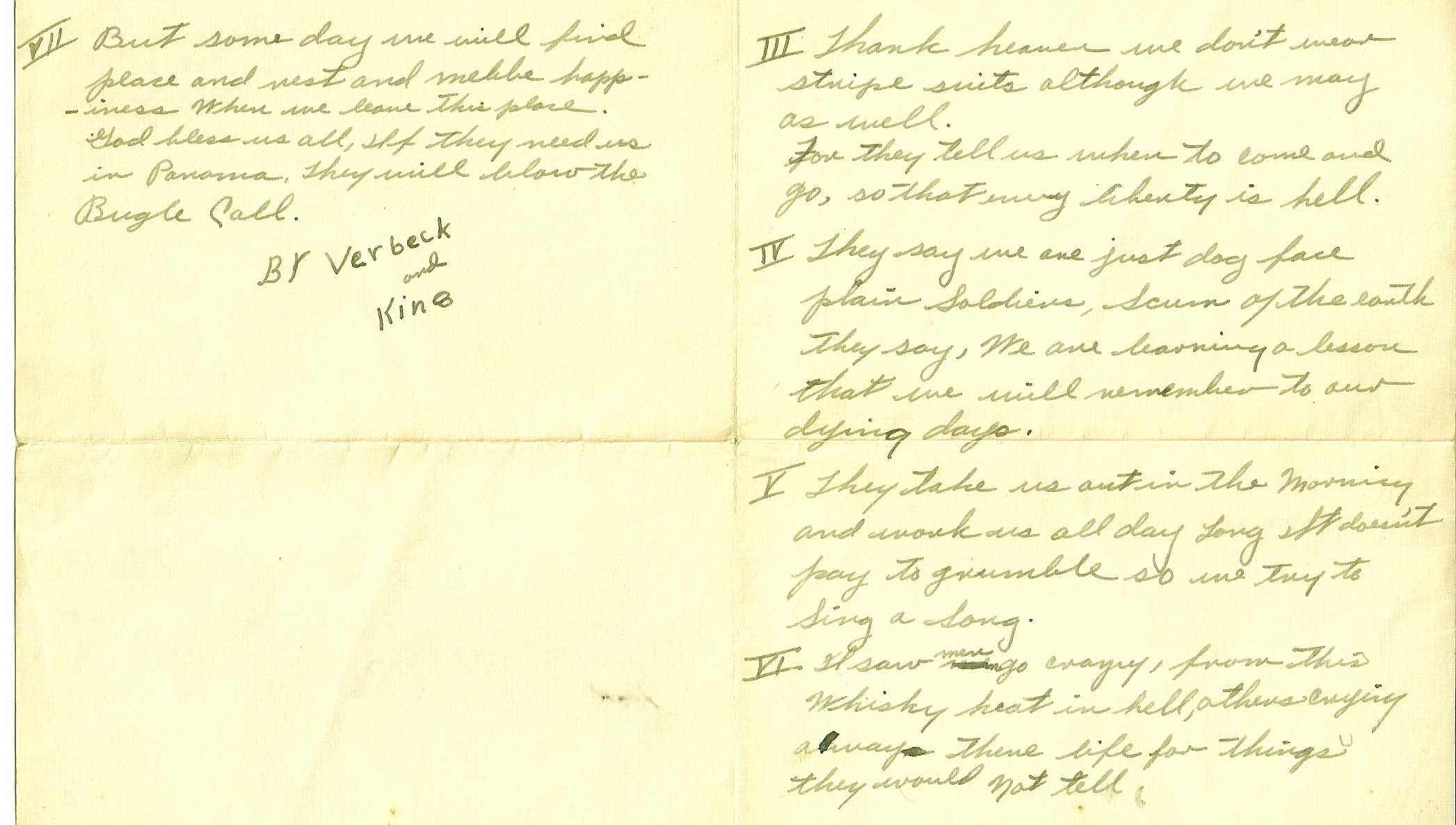
Read a transcription of the poem
Spelling and punctuation have been lightly standardized for readability. One difficult phrase is marked as uncertain.
Down in Panama
I. Down in Panama City in the torrid zone,
A thousand miles from no place,
Three thousand miles from home.
II. Don’t think that I am kicking
For the daily things we meet:
Mosquitoes flying around our heads,
And lizards crawling at our feet.
III. Thank heaven we don’t wear striped suits,
Although we may as well,
For they tell us when to come and go,
So that every liberty is hell.
IV. They say we are just dogface plain soldiers,
Scum of the earth.
They say we are learning a lesson
That we will remember to our dying days.
V. They take us out in the morning
And work us all day long.
It doesn’t pay to grumble,
So we try to sing a song.
VI. I saw men [word unclear] from this
Whiskey heat in hell,
Others crying away their life
For things they would not tell.
VII. But someday we will find
Peace and rest and maybe happiness
When we leave this place.
God bless us all; if they need us
In Panama, they will blow the bugle call.
—Verbeck and King
Before leaving for Europe, family memory says that King was able to visit Olivette one final time. It was the last time husband and wife were together. Their twin sons were born the following April, after his death.
What his surviving passes reveal
King’s enlistment record begins that trail on 8 January 1941, when he entered the Regular Army at Norfolk as a private—nearly a year before the attack on Pearl Harbor brought the United States into the war. The record places him initially in the Coast Artillery Corps or Army Mine Planter Service. Before enlistment, he had worked as a driver. Coast Artillery soldiers protected American harbors with heavy guns and controlled underwater minefields; the assignment was very different from the infantry fighting he would later face in Europe.
Two family-held military passes preserve later pieces that the enlistment index cannot supply. A Class A pass identifies him as a private first class in Company H, 174th Infantry, and authorized recreation privileges while he was at Camp Chaffee, Arkansas. A Good Conduct Pass dated 15 November 1943 places him at Fort Bliss, Texas, and permitted him to visit Ciudad Juárez, Mexico, when off duty. Together, the records document a progression from Coast Artillery service to the 174th Infantry and eventually the 315th Infantry. They do not, by themselves, establish Panama or the date of his final visit home.
Why parts of his military record may be missing
King’s Army personnel file belongs to a group severely affected by the 12 July 1973 fire at the National Personnel Records Center near St. Louis. The National Archives estimates that the fire destroyed about 80 percent of the files for Army personnel discharged between 1 November 1912 and 1 January 1960. Because no complete list of destroyed files exists, the fire alone does not prove that King’s entire file was lost. A surviving government response concerning his individual record could establish that more precisely. Meanwhile, passes, letters, morning reports, casualty records, and burial papers can help reconstruct portions of his service from other evidence.
A soldier of the 315th Infantry
King’s Portsmouth burial record identifies him as a private first class in the 315th Infantry Regiment, part of the U.S. Army’s 79th Infantry Division. The division was known by its Cross of Lorraine emblem. Its regiments fought from Normandy across northern France and into Lorraine and Alsace. Without King’s individual service file, it would be unsafe to assume that he took part in every one of the division’s earlier movements; the record establishes his regiment, not the date on which he joined it.
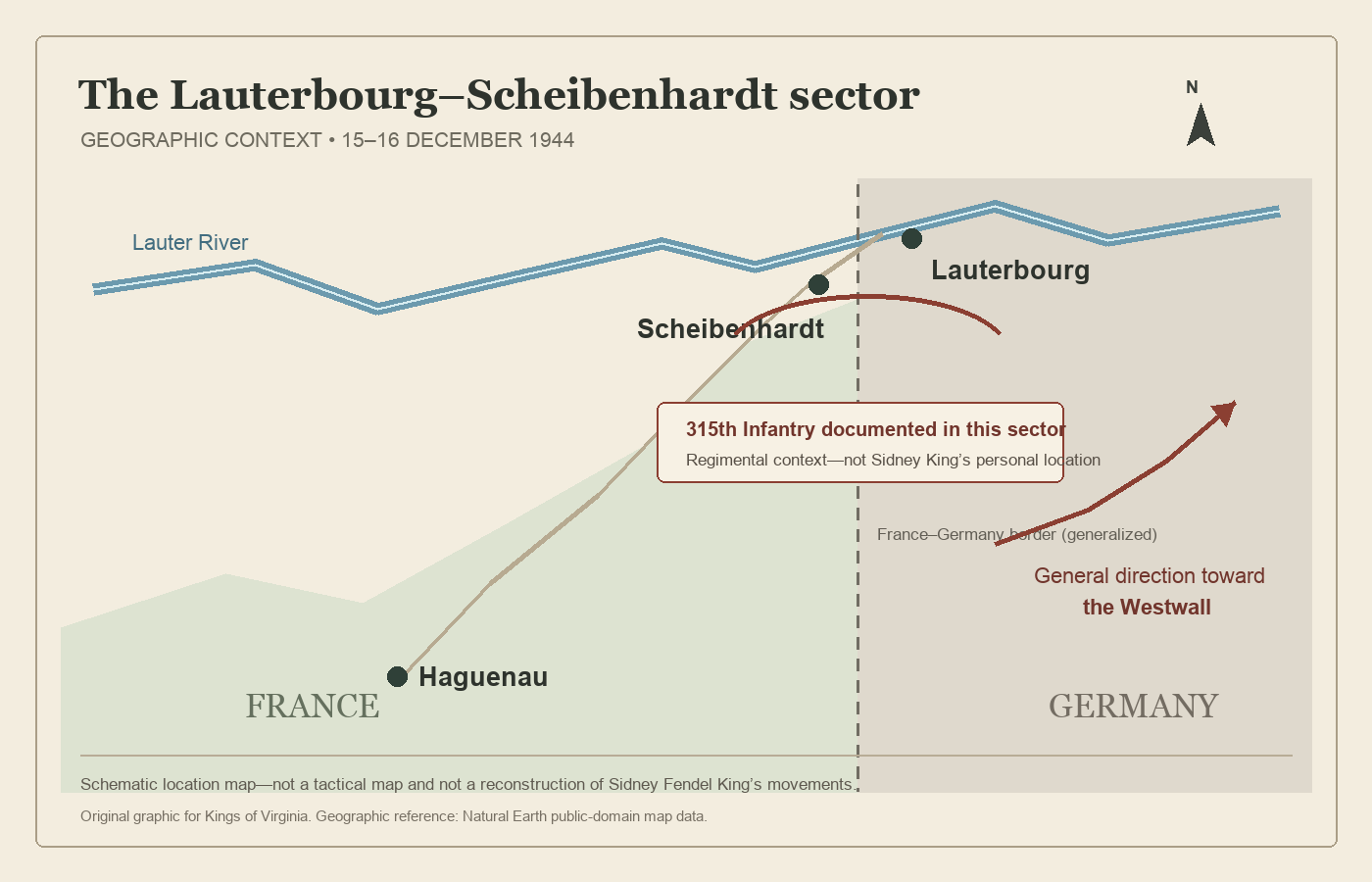
By mid-December 1944, the 79th Division was serving with the Seventh Army in northeastern France. The division had reached the Lauter River and the German frontier. Its next attacks would press toward the Siegfried Line through cold, mined, and heavily defended ground.
What happened on 16 December 1944?
King died on 16 December—the same day Germany opened the great offensive farther north that became known as the Battle of the Bulge. The date makes the family association with that battle understandable. The surviving division histories, however, place the 315th Infantry on the Alsace front, not in the Ardennes battle area.
Unit histories narrow the regimental setting further. The 79th Infantry Division’s combat history states that the division reached Lauterbourg and Scheibenhardt on the Lauter River on 15 December and that 2nd Battalion, 315th Infantry, constructed a footbridge west of Lauterbourg that day. A history of the neighboring 314th Infantry records that at 0645 on 16 December the 314th was ordered to prepare to cross the Lauter and move through the 315th Infantry’s position near Scheibenhardt. Together, these accounts place the 315th Infantry Regiment in the Lauterbourg–Scheibenhardt sector around the date of King’s death. They do not place King himself. His company and battalion remain unknown, so the evidence does not establish that he was in Scheibenhardt, crossed the Lauter, entered Germany, or participated in any particular action.
A neighboring regiment of the 79th Division was photographed advancing through Scheibenhard, France, at the German border that day.

Remembered in Alsace
On 15 September 2024, approximately eighty years after the fighting, the communities of Batzendorf, Niederschaeffolsheim, and Wahlenheim inaugurated a Cross of Lorraine memorial honoring the soldiers of the 79th U.S. Infantry Division and its affiliated units. The monument stands among villages liberated during the division’s advance through northern Alsace. Its dedication shows that the young Americans who fought there are still remembered by the communities they helped free.

The broader campaign was later designated “Ardennes-Alsace,” but those were distinct fighting areas. On the evidence presently available, the responsible description is that King died during the winter fighting in Alsace as the Battle of the Bulge began elsewhere. His company and battalion, exact location and circumstances of death, first burial location, and the evidence that may survive in morning reports and his Individual Deceased Personnel File remain open research questions.
The landscape in the photograph helps explain this less familiar front: border villages, churned roads, damaged buildings, short winter days, and fortified ground leading toward Germany’s Westwall. On 17 December, the day after King’s death, the 79th Division began its next attack toward those defenses. This sequence provides the setting around his final day, but it cannot substitute for the missing company-level record of what happened to him.
The long journey back to Portsmouth
A surviving family account says that King was first buried overseas and that an aunt arranged for his remains to be returned through Antwerp, Belgium. That detail fits the history of the Army’s postwar Return of the Dead program. Antwerp became a major departure point: in October 1947, the first large shipment from the European theater carried thousands of American dead from Belgium toward the United States.
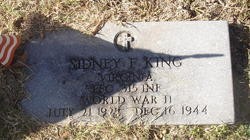
A federal headstone application is indexed in Sidney’s name, and family research also identifies paperwork requesting the transfer of his remains. Those records offer a promising route to establishing who made the request, where he was first buried, and when he returned to Virginia. Until the original forms are fully examined and transcribed, the name of the ship and the date of his return remain open questions. What is documented is his final resting place in Portsmouth, where his government marker records his name, rank, regiment, dates, and service in World War II.
A life measured by more than its length
The record leaves no need to exaggerate. Sidney Fendel King entered the Army during a world war, served in an infantry regiment fighting toward Germany, and was killed in action at twenty-two before he could meet his sons. A surviving Purple Heart engraved with his name preserves official recognition of that sacrifice. The portrait restores a face to the military notation. The grave restores a name to the casualty count. Together they preserve the young husband and father behind both.
Sources and research trail
- Portsmouth Public Library cemetery register, surnames I–L, entry for Sidney F. King, grave C169-6.
- The Cross of Lorraine: A Combat History of the 79th Infantry Division, including the division’s December 1944 operations and its roll of honor.
- Through Combat: 314th Infantry Regiment, including the 16 December order directing the neighboring 314th Infantry to move through the 315th Infantry’s position near Scheibenhardt.
- Jeffrey J. Clarke and Robert Ross Smith, Riviera to the Rhine, Chapter XIV, U.S. Army Center of Military History account of Seventh Army operations in Alsace.
- U.S. Army Signal Corps photograph of soldiers of the 79th Division advancing through Scheibenhard, France, 16 December 1944, Paris Musées, CC0.
- Wahlenheim municipal bulletin, December 2024, reporting the 15 September 2024 inauguration of the memorial honoring the 79th U.S. Infantry Division.
- Eurojournalist(e), “Gelebtes Gedenken”, report and CC BY 2.0 photograph of the memorial’s inauguration.
- Jon T. Hoffman, The Panama Canal: An Army’s Enterprise, U.S. Army Center of Military History, for the scale and mission of the wartime Canal defenses.
- National Archives, “The 1973 Fire, National Personnel Records Center”, explaining the destruction of Army personnel files and the use of auxiliary records for reconstruction.
- Obituary for Fendel King, preserving the twins’ birth date and the statement that they never met their father because of the war.
- National WWII Museum, SS Joseph V. Connolly leaving Antwerp in 1947, historical context for the return of American war dead; not proof that King was aboard this ship.
- Family-held military evidence: Class A pass, Good Conduct Pass dated 15 November 1943, named Purple Heart, and War Department file summary for PFC Sidney F. King. Examined for this exhibit; the private documents and identifying numbers are not reproduced online.
- Sidney F. King and Charles L. Verbeck, “Down in Panama,” undated handwritten manuscript associated with Fort Amador, Canal Zone, and signed “By Verbeck and King.” Private collection.
- U.S. World War II Army Enlistment Records, 1938–1946, entry for Sidney F. King, derived from the National Archives’ electronic Army Serial Number Merged File. The identifying service number is withheld from the public exhibit.